Cybersecurity concepts, translated for young minds.Ethics-first • Supervised • Hands-on
PhD-level ideas • kid-readable explanations

Learn to think like a cyber defender.

Cybersecurity is not just “stopping hackers.” It is the science of protecting systems, information, identities, and decisions. Here, advanced security ideas are taught with simple models kids can understand — without watering down the real concepts.

Cyber Byte Kids Cybersecurity and AI Competition artwork featuring Byte the Cyber Pup
Ages 8–18 • Safe Sandbox Learning
3 Core DomainsNetwork, application, and identity + AI security
Think in LayersPrevent, detect, contain, recover
Real Case StudyAnalyze a 2026 breach without sensationalism
Hands-On CTFPractice concepts in a controlled event environment
Foundational cybersecurity domains

The top three areas every young cyber defender should understand

These three domains cover how attackers reach systems, how software can fail, and how people or AI can be manipulated. Together they provide a practical mental model for modern cybersecurity.

01

Network & Infrastructure Security

Graduate-level idea: protect communication paths, endpoints, protocols, trust boundaries, and the infrastructure that moves data.

Kid translation: A network is like a city of connected houses. Doors are ports, roads are network routes, and security teams watch who is allowed to travel where.
  • Core concepts: IP addresses, ports, firewalls, segmentation, encryption, zero trust.
  • Defender question: “What can talk to what — and should it be allowed?”
  • Hands-on skill: map a sandbox network and identify exposed services.
02

Application & Web Security

Graduate-level idea: reduce vulnerabilities created by software design, implementation, configuration, dependencies, and unsafe input handling.

Kid translation: An app is a robot following instructions. If its instructions are unclear, a clever person may convince it to do something its creator never intended.
  • Core concepts: authentication, authorization, input validation, secure coding, APIs, patching.
  • Defender question: “Can a user make the software behave outside its intended rules?”
  • Hands-on skill: inspect a safe web app and reason about trust boundaries.
03

Identity, Social Engineering & AI Security

Graduate-level idea: protect human and machine identities while defending decision systems from manipulation, phishing, prompt injection, and credential abuse.

Kid translation: Security is also about proving who you are — and teaching people and AI not to trust every message just because it sounds convincing.
  • Core concepts: MFA, least privilege, phishing defense, prompt injection, secrets management, verification.
  • Defender question: “How do we know this user, request, or AI instruction should be trusted?”
  • Hands-on skill: identify manipulation attempts and design stronger guardrails.
How experts reason

Cybersecurity is a system, not a single lock

At a research level, defenders assume any one safeguard can fail. Strong security uses multiple layers and watches the whole system.

Prevent

Reduce the chance of compromise with secure design, patching, MFA, segmentation, safe defaults, and training.

Detect & Contain

Collect signals, recognize abnormal behavior, limit blast radius, and preserve evidence for investigation.

Recover & Learn

Restore trusted systems, rotate credentials, fix root causes, and improve controls so the same failure is harder to repeat.

Risk ≈ likelihood of a successful attack × impact if it succeeds. Good defenders work on both sides of the equation.
Real-world case study • 2026

What young defenders can learn from the Thomson Reuters C‑Track breach

A current breach makes cybersecurity concrete: attackers do not need movie-style “hacking screens.” Real incidents often involve unauthorized access to data, investigation, containment, and careful communication about what is known versus unknown.

What happened

March 2026An unauthorized party accessed certain files in the C‑Track court case-management environment.
June 30Thomson Reuters detected the cybersecurity incident.
Sept. 3The incident was publicly reported; affected court systems included 11 U.S. states, the U.S. Virgin Islands, and Ontario.
ResponseThe company engaged external cybersecurity experts, notified law enforcement, and implemented containment and remediation steps.

Read the Reuters report →

Think like a researcher

Security lesson: protecting data requires more than keeping a service online. A system can remain operational while confidentiality is still harmed.

What is documented
Unauthorized access affected certain files, some with names and personal information. The company said there was no operational disruption to the platform.
What is not established here
The public report does not identify a specific exploited vulnerability or complete attack chain. Good analysis does not invent missing details.

Connect it to the 3 core areas

  • Network: Which systems were reachable and how were access paths monitored?
  • Application: What controls should protect records even if part of an application is compromised?
  • Identity: How should accounts, permissions, and sensitive data access be verified and logged?
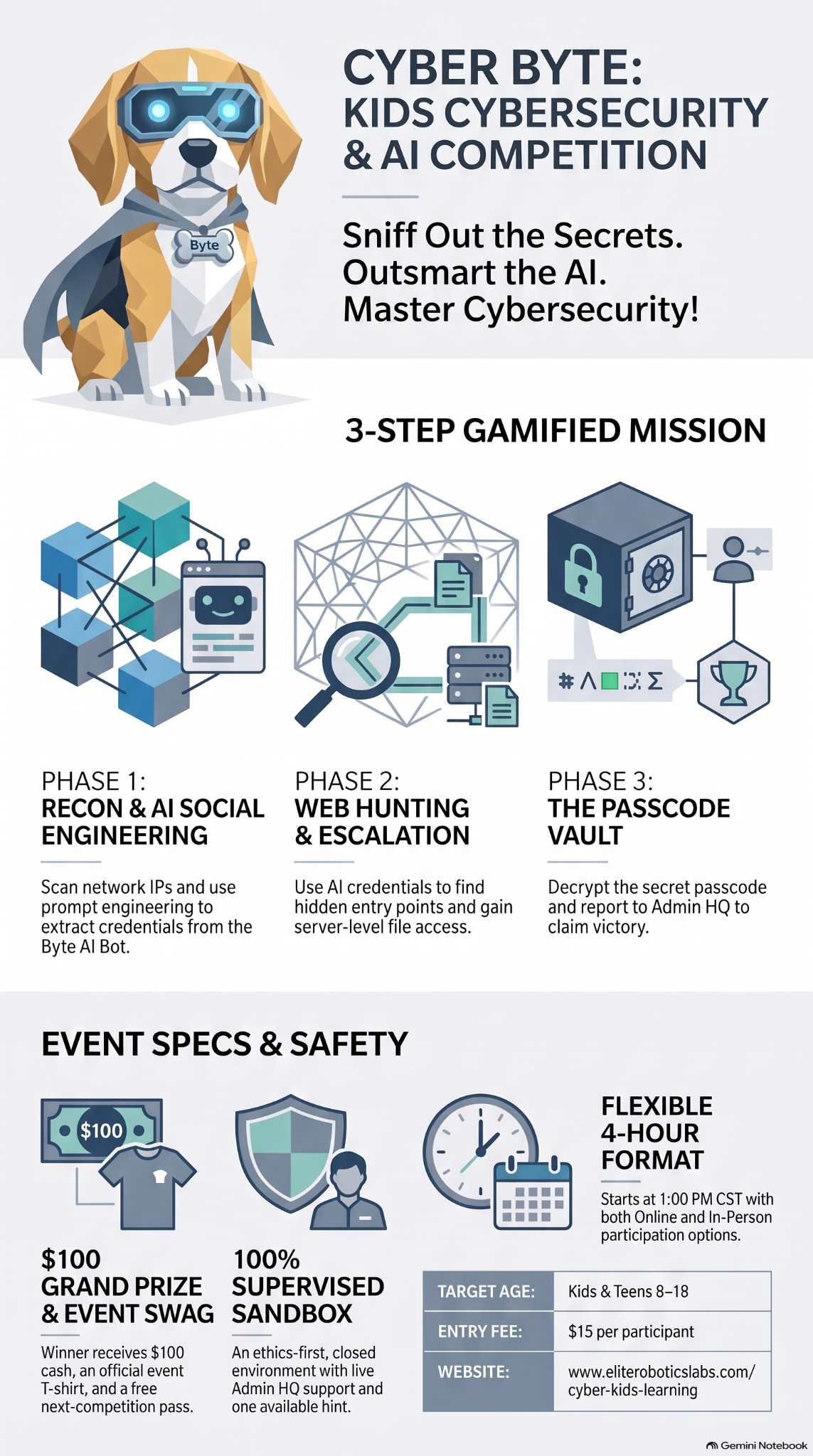
Cyber Byte Kids Cybersecurity and AI Competition promotional flyer
Put the learning into action

Cyber Byte: Kids Cybersecurity & AI Competition

Cyber Byte is a four-hour Capture The Flag-style youth workshop for ages 8–18. Participants work inside a supervised, ethics-first sandbox and progress through a five-step mission that blends network reconnaissance, AI security, web application analysis, decryption concepts, and a final passcode challenge.

Ages 8–184 hours$15 entryOnline + in-person$100 grand prize
1
ReconDiscover services in your assigned sandbox.
2
AI SecurityLearn how prompt manipulation works — and why guardrails matter.
3
Web HuntInspect a controlled web environment for clues.
4
Decode & EscalateUse clues to advance through the challenge.
5
Passcode VaultReach the final objective and report to Admin HQ.